Minneapolis roofs rarely fail in the open field of shingles. They fail at the joints, the spots where two materials meet or the roof plane changes direction. A pipe comes through the deck, a valley funnels two slopes into one channel, a wall rises out of the roofline. Each of those junctions depends on flashing rather than the shingle itself, and flashing is what wears, shifts, or was never detailed right the first time. This list runs from the most common entry points to the ones homeowners rarely think to check.
Pipe Boots and Vent Failures
A pipe boot is the rubber collar sealing the gap where a plumbing stack passes through the roof, and it is the single most common place a Minneapolis roof leaks. Rubber does not survive this climate indefinitely. It stiffens in the cold, softens in July, and after enough of those cycles it splits at the top of the collar where it grips the pipe. Once it opens, water runs down the outside of the pipe and into the attic at one precise spot, so the ceiling stain below shows up long before anything looks wrong from the street. The tell from inside is a damp collar, a stain running down the pipe, or a ring of frost around it in January.
Valleys Where Two Roof Planes Meet
A valley is where two roof slopes drain into a single channel, and Minneapolis foursquares and Colonial Revival homes with cross-gabled rooflines often have more than one. Every valley carries far more water than a flat run of shingles ever sees, plus whatever ice builds up there in a hard winter. If the valley metal or the woven shingles underneath it were cut short or nailed too close to the center, that's usually where the leak shows up first, not at the ridge or eaves.
Headwall and Sidewall Flashing Joints
Where a roof slope runs straight into a wall, headwall flashing catches the water head-on; where the roof runs alongside a wall instead, sidewall flashing and step flashing handle the runoff course by course. Additions and dormers on older homes near Lyn-Lake and Seward often created these joints well after the original roof went up, and a mismatched retrofit is a common weak spot. Once step flashing pulls loose or gets covered over, water tracks sideways into the wall framing.
Chimney Counterflashing Gaps
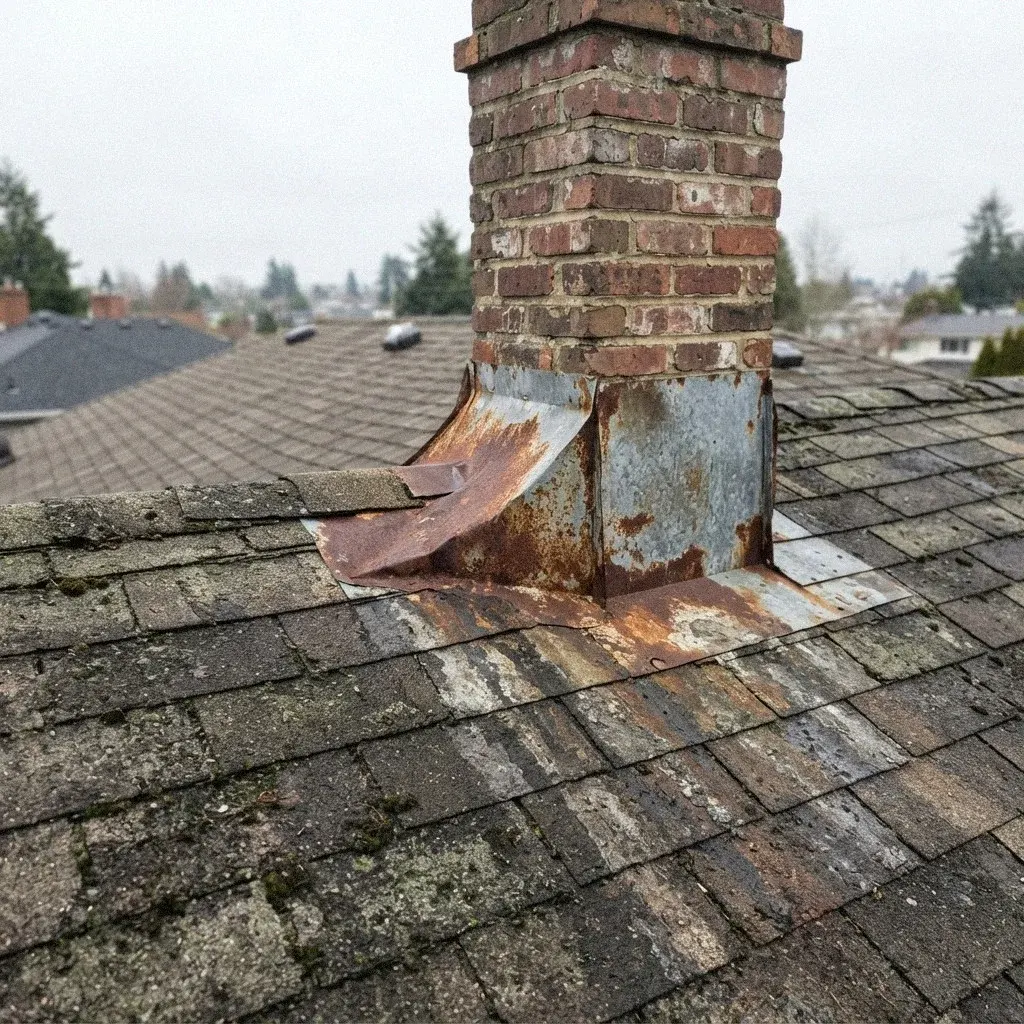
A chimney needs two separate pieces of flashing to work: base flashing that sits against the roof deck, and counterflashing set into the mortar joints above it, lapping down over the base piece. Minneapolis brick chimneys move slightly with the seasons as the ground and masonry expand and contract, and that movement can open a gap between the counterflashing and the brick. Once that gap opens, wind-driven rain during a summer thunderstorm can push water in sideways rather than straight down.
Skylight Curb Seal Failure
A skylight sits on a raised curb, and the seal between the unit and that curb is a wearing part. It takes the widest temperature swing of anything on the roof: coldest surface in the house on a January night, full sun by July afternoon. That daily movement works the gasket loose and eventually opens the joint. The confusing part is that a skylight can also stain a ceiling without leaking at all, because condensation forms on the cold glass and runs down the shaft. A leak starts high and keeps going while it rains or while snow melts; condensation shows up on dry, freezing nights and pools at the lowest point of the frame.
Kick-Out Flashing at Wall Bottoms
Kick-out flashing is a small angled piece of metal at the very bottom of a roof-to-wall junction, where a slope dead-ends against a wall above a gutter. Its only job is to throw the water running down that wall line out into the gutter instead of letting it carry on behind the siding. It costs almost nothing and it gets left off constantly, especially on older houses that were reroofed before anybody thought about it. When it is missing, water runs inside the wall cavity for years and never marks a ceiling, so nobody looks. The evidence is outside instead: peeling paint, soft trim, or rot on the siding directly below where that roof edge meets the wall.
Loose or Missing Exposed Fasteners
Beyond sidewalls, anywhere a lower roof section runs into a taller wall, or a second story sits above a one-story addition, that joint counts as a roof-to-wall transition. It needs step flashing woven into each shingle course and tied back into counterflashing above, not a bead of sealant alone. These transitions show up often on additions built behind the original roofline of a Powderhorn Park or Seward bungalow, where the new roof was tucked under an existing wall instead of properly flashed into it.
Eaves, Rakes, and Drip Edge
Drip edge is the metal L running along the eaves and up the rakes, and it does something simple: it pushes water off the edge of the deck and into the gutter instead of letting it curl back under the shingles and onto the fascia. Left off, or installed under the wrong layer, the fascia and the first few inches of decking take water every time it rains. In Minneapolis it matters twice over, because the eave is also where ice dams sit. A drip edge with an ice and water membrane behind it is what stands between backed-up meltwater and the sheathing, and a rusted or missing one at the eave is worth taking seriously well before the roof itself is due.
Exposed Fastener Wear Over Time
Any fastener left on the outside of the roof is on a clock. Vent flanges, gutter aprons, ridge caps on some older installs, and steel panel screws all rely on a rubber or neoprene washer squeezed under the head, and that washer is the part that fails. Cold hardens it, sun degrades it, and the metal it sits on expands and contracts underneath it. Once the washer stops sealing, the screw hole is simply a hole. What makes this a slow problem rather than an obvious one is that a single fastener passes very little water, so it soaks the deck around it for seasons before anyone sees a mark inside.
Underlayment as the Last Line
Underlayment is the water-resistant sheet laid across the deck before the shingles go down, and it's what a Minneapolis roof depends on once wind-driven rain from a summer storm gets past a flashing joint. Older homes in Near North or Whittier reroofed decades ago may have underlayment that's thinner or more brittle than what current products use. Where that layer has degraded, water that would have been stopped short of the deck instead reaches the plywood, and the leak traces back to the flashing above it, not the underlayment itself.
Why Joint Condition Beats Roof Age
Put all of it together and a pattern shows up: almost nothing on this list is the shingles. Boots, valleys, headwalls, chimneys, skylights, kick-outs, drip edge, fasteners. Every one is a joint, and joints fail on their own schedule regardless of how many years the field of the roof has left. That is why a roof with a decade of life in it can be leaking today, and why a roof past its rated years can be perfectly dry. So the useful question is not how old the roof is. It is when somebody last looked at every place the shingle field stops and something else takes over.
Dealing with this in your home?
Minneapolis roofs carry the weight of two seasons pulling in opposite directions. Bungalows near Kingfield and Longfellow trap heat in poorly vented attics, melting snow that refreezes at the eaves into ice dams. Come summer, hail off a Hennepin County thunderstorm can strip granules city-wide, no matter the neighborhood.